
Hodgeman County Court Records After Arrest
After a Hodgeman County arrest, the jail record and the court record split into two tracks. The jail record starts with booking, custody, arresting agency, release, transfer, and local hold information. The court record begins when the county attorney files charges in Hodgeman County District Court or when the court records a warrant, hearing, bond order, dismissal, diversion, plea, or sentence. The booking charge can be only an arrest label. It is not always the charge that appears in court.
The official Hodgeman County directory lists County Attorney Mark A. Cowell with phone 620-357-6411 and mailing/address information in Larned. The district court clerk is listed at 620-357-6522, with mailing address PO Box 187, Jetmore, KS 67854. The Kansas Judicial Branch Hodgeman County courthouse page lists the courthouse at 500 Main, PO Box 187, Jetmore, and gives public hours of 8 a.m. to noon and 1 p.m. to 5 p.m. Sheriff Jared Walker and the jail line are listed on the Kansas Sheriffs' Association Hodgeman County page for custody checks tied to the same arrest.
For custody and booking details, use the sheriff and Hodgeman County inmate records. For booking photos, use the Hodgeman County jail mugshots page because court records usually identify charges and filings, not jail photos.
Search Court Records After Arrest
The official statewide court lookup point is Kansas CaseSearch. The research could not inspect the exact live field inventory because command-line access was blocked, so no field table is invented here. Use the portal in a normal browser, search by defendant name or case number, and check the case entries for charges, hearings, bond orders, warrants, and disposition. If the case does not appear online, contact the Hodgeman County District Court clerk.
- Search Kansas CaseSearch by the person's name or a known case number.
- Open the matching criminal case and confirm it is in Hodgeman County or the 24th Judicial District.
- Read the filed charge list, charge level, case status, hearing dates, and bond entries.
- Compare the court filing with the jail booking record if the arrest charge and filed charge differ.
- Call the district court clerk at 620-357-6522 for public court-record questions that the portal does not answer.
The Kansas Bureau of Investigation criminal history record search is a different tool. It requires a KanAccess login, carries a $30 Kansas.gov purchase price in the research file, and is available from 4:00 a.m. to midnight Central. Use it for broader statewide criminal-history checks, not for jail custody.
Charges Filed After Hodgeman Arrest
A charging document is the court filing that turns an arrest into a criminal case. The Hodgeman County Attorney decides whether to file, which counts to file, and whether charges should be amended, reduced, dismissed, diverted, or resolved by plea or trial. A person may be arrested on one label and later face different filed charges because prosecutors review reports, evidence, witness statements, and legal elements before filing.
| Document | Who Usually Files It | What It Does |
|---|---|---|
| Complaint | Prosecutor or officer, depending on case type and procedure | Starts a criminal case with a written accusation. |
| Information | Prosecutor | States formal charges without a grand jury indictment. |
| Indictment | Grand jury | Charges a case after grand jury action, less common in routine local cases. |
Hodgeman County Charge Status
Court records after a jail arrest can change over time. A case may start with one count and later show amended counts, reduced charges, added counts, dismissal, diversion, plea, trial, sentence, or probation. A pending charge is an accusation, not a conviction. A conviction follows a plea, verdict, or other final adjudication. CaseSearch and the court clerk are better sources for charge status than a jail booking sheet.
| Status | What It Means | Where to Confirm |
|---|---|---|
| Pending | The case or charge remains open and unresolved. | CaseSearch or district court clerk |
| Amended | The prosecutor or court changed the original charge language, level, or count. | Court docket and filings |
| Dismissed | The charge or case was dropped by court order or prosecution action. | Court docket and order |
| Diversion | The case may be resolved through conditions instead of a conviction if completed. | Court or prosecutor record |
| Disposed | The case reached an outcome, such as plea, trial result, dismissal, or sentence. | Court docket |
Bond Orders After Hodgeman Arrest
Hodgeman County does not publish a local online bond schedule or bond-payment instruction page in the sources reviewed. Bond questions should be confirmed with the sheriff/jail at (620) 357-8391 and with the court record or district court clerk for case-specific orders. Kansas commonly uses cash bond, surety bond through a licensed bondsman, personal recognizance release, and no-bond or hold statuses, depending on the warrant, offense, and judge's order.
| Bond Type | How It Works | Key Risk |
|---|---|---|
| Cash bond | Cash is posted as security for court appearance. | Payment location and hours must be confirmed locally. |
| Surety bond | A licensed bail agent posts bond under a surety agreement. | Fees and eligibility are not the court bond amount. |
| PR bond | Release is based on a promise to appear. | Conditions may still apply. |
| No-bond hold | Release is blocked until court or agency action. | Another county, probation, parole, federal, or ICE hold can delay release. |
Warrants and Arrest Court Records
No official Hodgeman County active-warrant list or searchable warrant portal was located. A warrant can lead to jail booking when law enforcement arrests the person. Public warrant questions may route through the sheriff at (620) 357-8391 or the Hodgeman County District Court clerk at 620-357-6522. Kansas CaseSearch may show warrant-related case events, but it is not a complete warrant-clearance system.
Warrant record fields to ask for, when public, include name, warrant type, issuing court, case number, charge or alleged violation, bond amount or type, issue date, and originating agency. Do not rely on a web search alone before approaching law enforcement. Contact the court or an attorney about how to resolve or clear a warrant.
Charges vs Convictions
Court records after arrest can show an accusation before any guilt finding. This distinction matters for employment, housing, licensing, family, and personal safety decisions. A jail booking means a person entered custody or was processed. A filed charge means a prosecutor or court placed an accusation in the case record. A conviction means the case reached a guilty plea, verdict, or other final finding that the law treats as a conviction.
| Record Point | Charge | Conviction |
|---|---|---|
| Stage | Accusation after arrest or filing | Final result after plea, verdict, or qualifying finding |
| Proof | Not proof of guilt | Legal finding or admission |
| Can change? | May be amended, reduced, dismissed, or diverted | May be appealed, modified, or later expunged if eligible |
Sealed and Expunged Arrest Records
Kansas uses expungement for certain convictions, arrest records, and diversion agreements under K.S.A. 21-6614. The research does not support a promise that every Hodgeman County arrest record or mugshot can be removed. Eligibility depends on the case type, outcome, waiting period, prior record, and court order. A dismissed charge may still have a public record until a court grants relief or the agency updates its record under the law.
| Term | Plain Meaning | Hodgeman County Path |
|---|---|---|
| Sealed | Public access is restricted by court rule or order. | Ask the district court clerk about the case record. |
| Expunged | An eligible record is cleared or treated as removed under statute. | Use the Kansas expungement process in the court with jurisdiction. |
| Nonpublic | A record is withheld because an exception applies. | KORA and court rules control access. |
Kansas Public Access Limits
KORA supports public access, but it also includes exceptions. K.S.A. 45-221 lists exceptions to disclosure and includes annotations that reference law-enforcement records, jail books, inmate rosters, and mug shots. K.S.A. 45-216 covers inspection, agency response, refusal, and fees. Those laws explain why a court or sheriff may provide some fields, redact others, or route a request to a different office.
The Kansas Judicial Branch courthouse page is the source for local court location and hours.
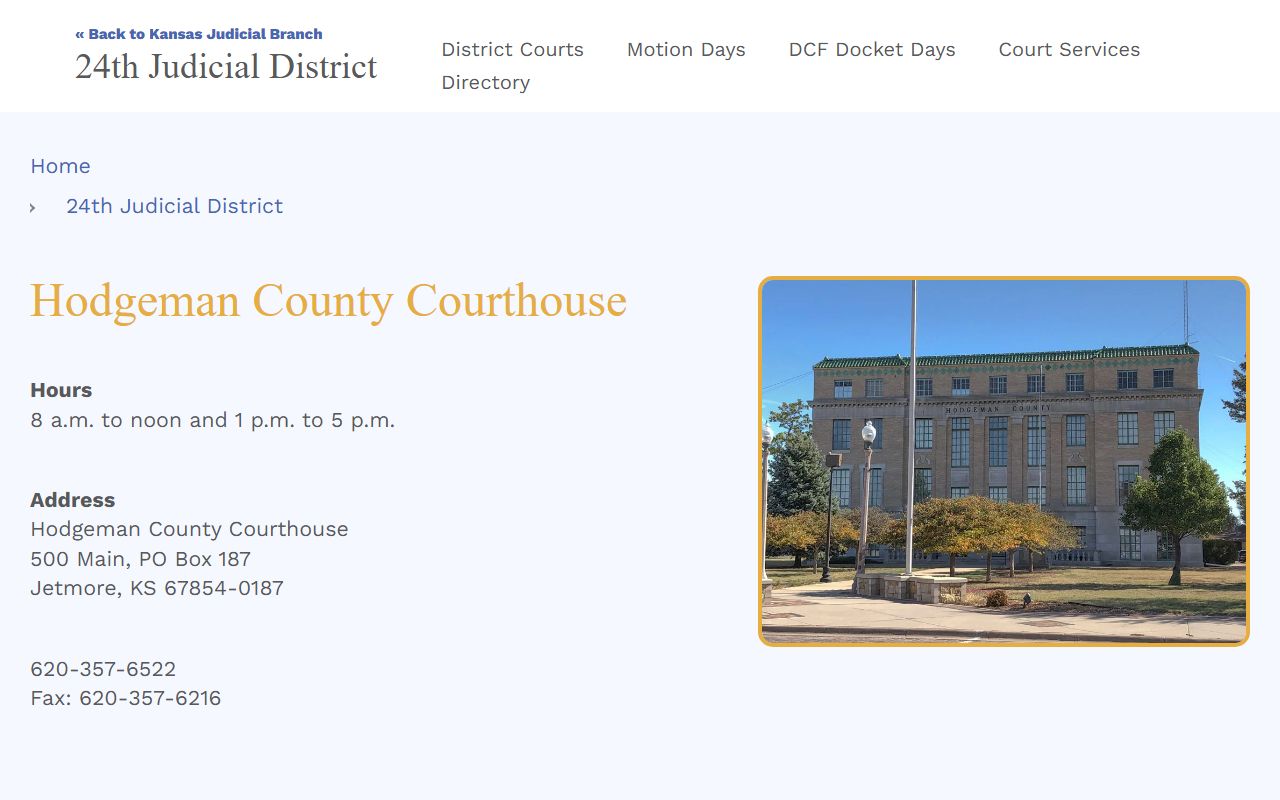
The courthouse source connects the arrest-to-court path to the local district court clerk, which is the record contact once charges are filed.